
iOS 開發:使用 XCTest 進行單元測試
測試驅動開發(TDD)是目前流行的開發理念,而 XCTest 正是 Apple 封裝的單元測試類庫。使用 XCTest 進行單元測試的流程相當簡單,本文僅簡單介紹 XCTest 的用法;但對於單元測試的理解(何時使用、如何更高效地驅動開發),卻是一個需要長期積累的過程,要在 TDD 的實踐中細細體會。
setUp 與 tearDown
一個測試用例以一個 Objective-C 類別的形式存在,其 implementation 中有預設的 setUp 與 tearDown 方法,分別用於處理用例執行前的準備工作與執行完畢後的清理工作。
- (void)setUp { [super setUp]; // Put setup code here. This method is called before the invocation of each test method in the class. } - (void)tearDown { // Put teardown code here. This method is called after the invocation of each test method in the class. [super tearDown]; }
因此,我們常在 setUp 中進行基本物件的初始化等一些必要步驟。
單元測試
所有以 test 開頭的實例方法(不能帶參數)都是一個完整的單元測試 case。

最左邊有個小圖示,點擊它即可執行該測試 case。
性能測試
性能測試可直接使用 - (void)measureBlock:(void (^)(void))block; 進行,傳入的參數即為要執行任務所組成的一個 block。例如下方的 case 就可用來測試 measureBlock 所接收的 block 參數中執行的性能。
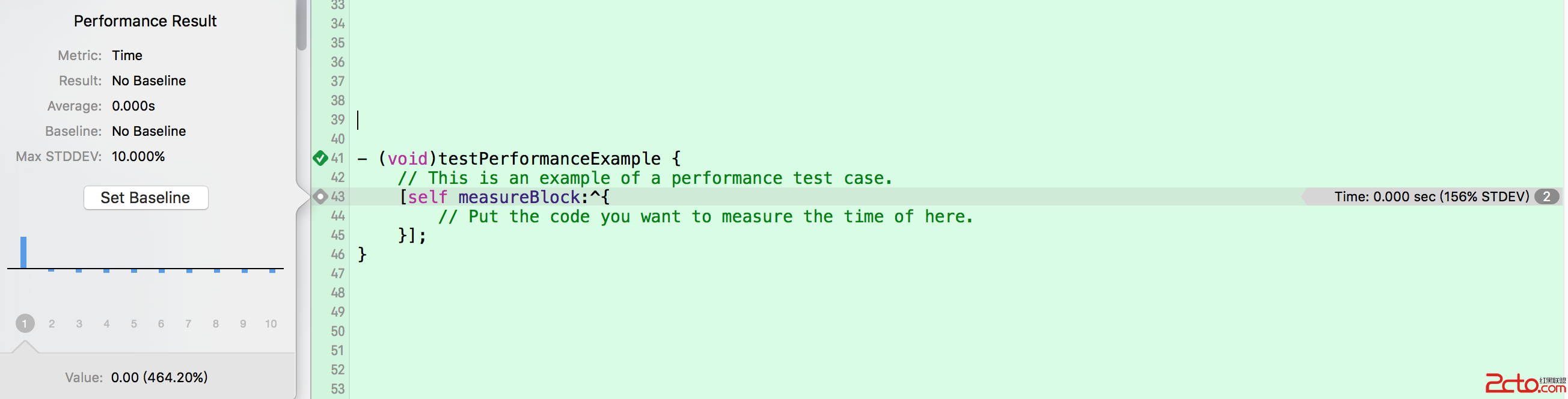
Baseline 即可設定該性能是否合格的參考基準。
請注意,一個性能測試 case 中只能執行一次 measureBlock,也就是只能測試一個指定 block 步驟的性能(這其實也合乎情理,混在一塊兒還怎麼區分出性能測試的結果)。因此,在 while、for 等迴圈中是不能使用 measureBlock 的,否則會出錯。
measureMetrics 的用法與 measureBlock 類似。當然,也可以使用 startMeasuring 與 stopMeasuring 方法進行性能測試,但絕大多數情況下使用 measureBlock 已經足夠了。
性能測試的巨集定義
舉例來說,在單獨測試一個圖片濾鏡的性能時,可以這樣寫:
- (void)testPerformanceFilter1 { [self measureBlock:^{ NSInteger filterid = 100; UIImage *filteredImage = [FilterTool filterImage:self.image withFilterId:filterid]; XCTAssertNotNil(filteredImage, @"濾鏡效果圖應該非空"); }]; }
那麼,如果有幾十個濾鏡需要進行性能測試呢?
由於單元測試 case 的方法名不能傳遞參數,且迴圈中不能使用 measureBlock,因此對於大量重複的性能測試 case,目前看來採用巨集定義是比較好的解決方法。
#define TestFilterPerformance(filterid) - (void)testFilterPerformance_##filterid { \ [self measureBlock:^{ \ UIImage *filteredImage = [FilterTool filterImage:self.image withFilterId:filterid]; \ XCTAssertNotNil(filteredImage, @"濾鏡效果圖應該非空"); \ }]; \ }
如此一來,使用時便可如下定義所有的測試 case 了。

異步測試
XCTest 提供了 XCTestExpectation 來進行異步測試,即可在指定時機使用其 fulfill 實例方法來開始執行斷言命令。例如以下就是一個完整的網路請求測試樣例,可用來測試 server 端是否正常,要在對應的 block 中進行斷言。
- (void)testAsynchronousURLConnection { XCTestExpectation *expectation = [self expectationWithDescription:@"GET Baidu"]; NSURL *url = [NSURL URLWithString:@"https://www.baidu.com/"]; NSURLSession *session = [NSURLSession sharedSession]; NSURLSessionDataTask *task = [session dataTaskWithURL:url completionHandler:^(NSData * _Nullable data, NSURLResponse * _Nullable response, NSError * _Nullable error) { // XCTestExpectation條件已滿足,接下來的測試可以執行了。 [expectation fulfill]; XCTAssertNotNil(data, @"返回數據不應非nil"); XCTAssertNil(error, @"error應該為nil"); if (nil != response) { NSHTTPURLResponse *httpResponse = (NSHTTPURLResponse *)response; XCTAssertEqual(httpResponse.statusCode, 200, @"HTTPResponse的狀態碼應該是200"); XCTAssertEqual(httpResponse.URL.absoluteString, url.absoluteString, @"HTTPResponse的URL應該與請求的URL一致"); } else { XCTFail(@"返回內容不是NSHTTPURLResponse類型"); } }]; [task resume]; // 超時後執行 [self waitForExpectationsWithTimeout:10 handler:^(NSError * _Nullable error) { [task cancel]; }]; }
也就是說:異步網路請求操作正常執行,但斷言命令僅在 [expectation fulfill]; 之後才開始執行,這樣能確保取得網路請求的回應結果後再執行相應斷言。同時,還可設定超時時間及對應操作;否則,就需要使用定時機制等手段來處理類似情況。
存取待測類的私有變量
在 case 中,該如何存取一個待測類的私有變量呢?只要對該類進行相應的擴充即可。
#import #import "FilterTool.h" @interface FilterTool (UnitTest) @property (strong, nonatomic) FilterController *filterController; - (void)didSelectFilterCellAtIndexPath:(NSIndexPath *)indexPath; @end @interface FilterToolTest : XCTestCase @end @implementation FilterToolTest XXXX @end
FilterTool 類的 filterController 屬性與 didSelectFilterCellAtIndexPath: 方法本是私有的,若想對其進行測試,就必須把它們加入擴充之中。
斷言命令
XCTFail(format…) 生成一個失敗的測試; XCTAssertNil(a1, format...)為空判斷,a1為空時通過,反之不通過; XCTAssertNotNil(a1, format…)不為空判斷,a1不為空時通過,反之不通過; XCTAssert(expression, format...)當expression求值為TRUE時通過; XCTAssertTrue(expression, format...)當expression求值為TRUE時通過; XCTAssertFalse(expression, format...)當expression求值為False時通過; XCTAssertEqualObjects(a1, a2, format...)判斷相等,[a1 isEqual:a2]值為TRUE時通過,其中一個不為空時,不通過; XCTAssertNotEqualObjects(a1, a2, format...)判斷不等,[a1 isEqual:a2]值為False時通過, XCTAssertEqual(a1, a2, format...)判斷相等(當a1和a2是 C語言標量、結構體或聯合體時使用,實際測試發現NSString也可以); XCTAssertNotEqual(a1, a2, format...)判斷不等(當a1和a2是 C語言標量、結構體或聯合體時使用); XCTAssertEqualWithAccuracy(a1, a2, accuracy, format...)判斷相等,(double或float類型)提供一個誤差范圍,當在誤差范圍(+/-accuracy)以內相等時通過測試; XCTAssertNotEqualWithAccuracy(a1, a2, accuracy, format...) 判斷不等,(double或float類型)提供一個誤差范圍,當在誤差范圍以內不等時通過測試; XCTAssertThrows(expression, format...)異常測試,當expression發生異常時通過;反之不通過;(很變態) XCTAssertThrowsSpecific(expression, specificException, format...) 異常測試,當expression發生specificException異常時通過;反之發生其他異常或不發生異常均不通過; XCTAssertThrowsSpecificNamed(expression, specificException, exception_name, format...)異常測試,當expression發生具體異常、具體異常名稱的異常時通過測試,反之不通過; XCTAssertNoThrow(expression, format…)異常測試,當expression沒有發生異常時通過測試; XCTAssertNoThrowSpecific(expression, specificException, format...)異常測試,當expression沒有發生具體異常、具體異常名稱的異常時通過測試,反之不通過; XCTAssertNoThrowSpecificNamed(expression, specificException, exception_name, format...)異常測試,當expression沒有發生具體異常、具體異常名稱的異常時通過測試,反之不通過.
- 上一篇文章: 使用 CocoaPods 安裝第三方框架的實用教學
- 下一篇文章: iOS 開發:使用 delegate 進行訊息傳遞