Runtime那些事兒(消息機制)

本文是投稿文章,作者:HenryCheng
一、關於runtime
之前在項目中有遇到過用runtime解決改變全局字體的問題,所以再一次感受到了runtime黑魔法的強大,趁現在有機會分享一下對runtime的一些理解。在對象調用方法是Objective-C中經常使用的功能,也就是消息的傳遞,而Objective-C是C的超集,所以和C不同的是,Objective-C使用的是動態綁定,也就是runtime。Objective-C的消息傳遞和消息機制也就不多說了,今天主要說的是動態方法,也就是函數的調用。
二、相關的幾個函數
下面一張圖詳細的概括了每個函數調用的先後以及執行的前提
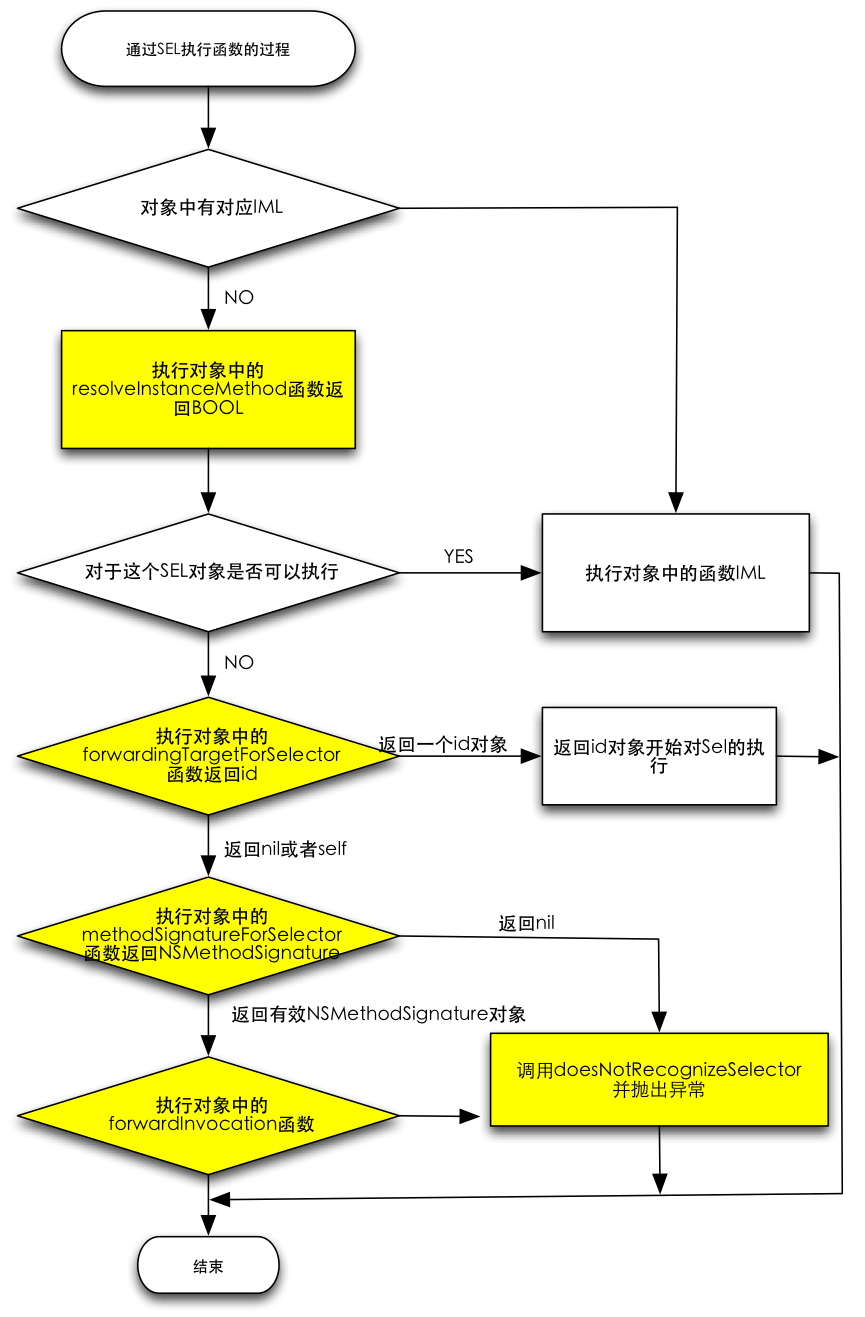
消息傳遞函數的調用
1.對象在收到無法解讀的消息後,首先會調用所屬類的
+ (BOOL)resolveInstanceMethod:(SEL)sel
這個方法在運行時,沒有找到SEL的IML時就會執行。這個函數是給類利用class_addMethod添加函數的機會。根據文檔,如果實現了添加函數代碼則返回YES,未實現返回NO。舉個例子,新建了一個工程,首先我在ViewController這個類中執行doSomething1這個方法,代碼如下
//
//  ViewController.m
//  RuntimeTest1
//
//  Created by HenryCheng on 15/12/24.
//  Copyright ?(版權符號) 2015年 www.igancao.com  All rights reserved.
//

#import "ViewController.h"

@interface ViewController ()

@end

@implementation ViewController

- (void)viewDidLoad {
    [super viewDidLoad];
    [self performSelector:@selector(doSomething)];
}

- (void)didReceiveMemoryWarning {
    [super didReceiveMemoryWarning];
    // Dispose of any resources that can be recreated.
}

@end
運行結果
**2015-12-24 10:35:37.726 RuntimeTest1[1877:337842] -[ViewController doSomething]: unrecognized selector sent to instance 0x7fe9f3736680**
**2015-12-24 10:35:37.729 RuntimeTest1[1877:337842] *** Terminating app due to uncaught exception 'NSInvalidArgumentException', reason: '-[ViewController doSomething]: unrecognized selector sent to instance 0x7fe9f3736680'**
***** First throw call stack:**
不出意外,程序崩潰,因為沒有找到doSomething這個方法,下面我們在裡面實現 + (BOOL)resolveInstanceMethod:(SEL)sel這個方法,並且判斷如果SEL 是doSomething那就輸出add method here
//
//  ViewController.m
//  RuntimeTest1
//
//  Created by HenryCheng on 15/12/24.
//  Copyright ?(版權符號) 2015年 www.igancao.com All rights reserved.
//

#import "ViewController.h"

@interface ViewController ()

@end

@implementation ViewController

- (void)viewDidLoad {
    [super viewDidLoad];
    [self performSelector:@selector(doSomething)];
}

+ (BOOL)resolveInstanceMethod:(SEL)sel {
    if (sel == @selector(doSomething)) {
        NSLog(@"add method here");
        return YES;
    }
    return [super resolveInstanceMethod:sel];
}

- (void)didReceiveMemoryWarning {
    [super didReceiveMemoryWarning];
    // Dispose of any resources that can be recreated.
}

@end
繼續運行,然後看到log
**2015-12-24 10:47:24.687 RuntimeTest1[2007:382077] add method here**
**2015-12-24 10:47:24.687 RuntimeTest1[2007:382077] -[ViewController doSomething]: unrecognized selector sent to instance 0x7f9568c331f0**
**2015-12-24 10:47:24.690 RuntimeTest1[2007:382077] *** Terminating app due to uncaught exception 'NSInvalidArgumentException', reason: '-[ViewController doSomething]: unrecognized selector sent to instance 0x7f9568c331f0'**
***** First throw call stack:**
可以看到程序依然是崩潰了,但是我們可以看到輸出了add method here,這說明我們 + (BOOL)resolveInstanceMethod:(SEL)sel這個方法執行了,並進入了判斷,所以,在這兒,我們可以做一下操作,使這個方法得到相應,不至於走到最後- (void)doesNotRecognizeSelector:(SEL)aSelector這個方法中而崩掉了,接下來,我麼繼續操作,如下
//
//  ViewController.m
//  RuntimeTest1
//
//  Created by HenryCheng on 15/12/24.
//  Copyright ?(版權符號) 2015年 www.igancao.com All rights reserved.
//

#import "ViewController.h"

#import [objc/runtime.h](因識別問題,此處將尖括號改為方括號)

@interface ViewController ()

@end

@implementation ViewController

- (void)viewDidLoad {
    [super viewDidLoad];
    [self performSelector:@selector(doSomething)];
}

+ (BOOL)resolveInstanceMethod:(SEL)sel {
    if (sel == @selector(doSomething)) {
        NSLog(@"add method here");
        class_addMethod([self class], sel, (IMP)dynamicMethodIMP, "v@:");
        return YES;
    }
    return [super resolveInstanceMethod:sel];
}
void dynamicMethodIMP (id self, SEL _cmd) {
    NSLog(@"doSomething SEL");
}

- (void)didReceiveMemoryWarning {
    [super didReceiveMemoryWarning];
    // Dispose of any resources that can be recreated.
}

@end
導入了
**2015-12-24 11:45:11.934 RuntimeTest1[2284:478571] add method here**
**2015-12-24 11:45:11.934 RuntimeTest1[2284:478571] doSomething SEL**
這時候我們發現,程序並沒有崩潰,而且還輸出了doSomething SEL,這時候就說明我們已經通過runtime成功的向我們這個類中添加了一個方法。關於class_addMethod這個方法,是這樣定義的
OBJC_EXPORT BOOL class_addMethod(Class cls, SEL name, IMP imp, const char *types)
cls 在這個類中添加方法,也就是方法所添加的類
name 方法名,這個可以隨便起的
imp 實現這個方法的函數
types 定義該數返回值類型和參數類型的字符串,這裡比如"v@:",其中v就是void,帶表返回類型就是空,@代表參數,這裡指的是id(self),這裡:指的是方法SEL(_cmd),比如我再定義一個函數
int newMethod (id self, SEL _cmd, NSString *str) {

  return 100;
}
那麼添加這個函數的方法就應該是ass_addMethod([self class], @selector(newMethod), (IMP)newMethod, "i@:@");
2.如果在+ (BOOL)resolveInstanceMethod:(SEL)sel中沒有找到或者添加方法
消息繼續往下傳遞到- (id)forwardingTargetForSelector:(SEL)aSelector看看是不是有對象可以執行這個方法,我們來重新建個工程,然後新建一個叫SecondViewController的類,裡面有一個- (void)secondVCMethod方法,如下
//
//  SecondViewController.m
//  RuntimeTest2
//
//  Created by HenryCheng on 15/12/24.
//  Copyright ?(版權符號) 2015年  www.igancao.com All rights reserved.
//

#import "SecondViewController.h"

@interface SecondViewController ()

@end

@implementation SecondViewController

- (void)viewDidLoad {
    [super viewDidLoad];
    // Do any additional setup after loading the view.
}

- (void)secondVCMethod {
    NSLog(@"This is secondVC method !");
}

- (void)didReceiveMemoryWarning {
    [super didReceiveMemoryWarning];
    // Dispose of any resources that can be recreated.
}

/*
#pragma mark - Navigation

// In a storyboard-based application, you will often want to do a little preparation before navigation
- (void)prepareForSegue:(UIStoryboardSegue *)segue sender:(id)sender {
    // Get the new view controller using [segue destinationViewController].
    // Pass the selected object to the new view controller.
}
*/

@end
工程結構應該是這樣的
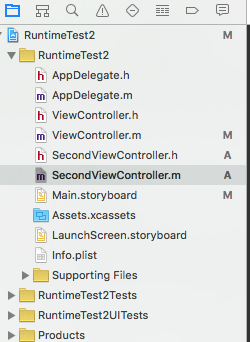
工程目錄圖
現在我想在ViewController中調用- (void)secondVCMethod這個方法,我們知道ViewController和SecondViewController並無繼承關系,按照正常的步驟去做程序肯定會因為在ViewController找不到- (void)secondVCMethod這個方法而直接崩潰的
//
//  ViewController.m
//  RuntimeTest2
//
//  Created by HenryCheng on 15/12/24.
//  Copyright ?(版權符號) 2015年 www.igancao.com  All rights reserved.
//

#import "ViewController.h"
#import @interface ViewController ()

@end

@implementation ViewController

- (void)viewDidLoad {
    [super viewDidLoad];
     [self performSelector:@selector(secondVCMethod)];
}

- (void)didReceiveMemoryWarning {
    [super didReceiveMemoryWarning];
    // Dispose of any resources that can be recreated.
}

@end
運行結果
**2015-12-24 13:54:44.314 RuntimeTest2[3164:835814] -[ViewController secondVCMethod]: unrecognized selector sent to instance 0x7fc3a8535c10**
**2015-12-24 13:54:44.317 RuntimeTest2[3164:835814] *** Terminating app due to uncaught exception 'NSInvalidArgumentException', reason: '-[ViewController secondVCMethod]: unrecognized selector sent to instance 0x7fc3a8535c10'**
***** First throw call stack:**
現在我們來處理一下這個消息,如下
//
//  ViewController.m
//  RuntimeTest2
//
//  Created by HenryCheng on 15/12/24.
//  Copyright ?(版權符號) 2015年 www.igancao.com All rights reserved.
//

#import "ViewController.h"
#import @interface ViewController ()

@end

@implementation ViewController

- (void)viewDidLoad {
    [super viewDidLoad];
     [self performSelector:@selector(secondVCMethod)];
}

- (id)forwardingTargetForSelector:(SEL)aSelector {
    Class class = NSClassFromString(@"SecondViewController");
    UIViewController *vc = class.new;
    if (aSelector == NSSelectorFromString(@"secondVCMethod")) {
        NSLog(@"secondVC do this !");
        return vc;
    }

    return nil;
}

+ (BOOL)resolveInstanceMethod:(SEL)sel {

    return [super resolveInstanceMethod:sel];
}

- (void)didReceiveMemoryWarning {
    [super didReceiveMemoryWarning];
    // Dispose of any resources that can be recreated.
}
@end
運行結果
**2015-12-24 14:00:34.168 RuntimeTest2[3284:870957] secondVC do this !**
**2015-12-24 14:00:34.169 RuntimeTest2[3284:870957] This is secondVC method !**
我們會發現- (void)secondVCMethod這個方法執行了,程序也並沒有崩潰,原因就是在這一步
- (id)forwardingTargetForSelector:(SEL)aSelector {
    Class class = NSClassFromString(@"SecondViewController");
    UIViewController *vc = class.new;
    if (aSelector == NSSelectorFromString(@"secondVCMethod")) {
        NSLog(@"secondVC do this !");
        return vc;
    }

    return nil;
}
在沒有找到- (void)secondVCMethod這個方法的時候,消息繼續傳遞,直到- (id)forwardingTargetForSelector:(SEL)aSelector,然後我在裡面創建了一個SecondViewController的對象,並且判斷如過有這個方法,就返回SecondViewController的對象。這個函數就是消息的轉發,在這兒我們成功的把消息傳給了SecondViewController,然後讓它來執行,所以就執行了那個方法。同時,也相當於完成了一個多繼承!
三、最後一點
當然,還有好幾個函數,在上面那張圖裡面已經清晰的表達了,有興趣的可以自己試試,看看消息的傳遞順序到底是怎麼樣的。上面提到的這些知識runtime的冰山一角,runtime黑魔法的強大遠不止於此,比如方法的調配(Method Swizzling)等,在項目實戰中還是很有用的,後面有時間會再介紹.
參考
Objective-C Runtime Reference
Objective-C Runtime Programming Guide

- 進修iOS自界說導航掌握器UINavigationController
- iOS 開辟中 NavigationController常常湧現的成績緣由剖析
- iOS簡略登錄LoginViewController、注冊RegisterViewController等功效完成辦法
- ios開辟navigationController pushViewController 方法屢次跳轉前往到最下層前往到指定的某一層的完成辦法
- iOS突變圓環扭轉動畫CAShapeLayer CAGradientLayer
- UIMenuController在Cell外部沒法顯示的處理方法(iOS9.2)
- iOS中navigationController 去失落配景圖片、去失落底部線條的焦點代碼
- iOS Runntime 靜態添加類辦法並挪用-class_addMethod
- iOS應用runtime修正文本框(TextField)的占位文字色彩
- 總結iOS中runtime的應用
- iOS App開辟中UIViewController類的應用教程
- 實例講授iOS中的UIPageViewController翻頁視圖掌握器
- iOS中長按調出菜單組件UIMenuController的應用實例
- iOS App開辟中的UISegmentedControl分段組件用法總結
- iOS App開辟中的UIPageControl分頁控件應用小結